
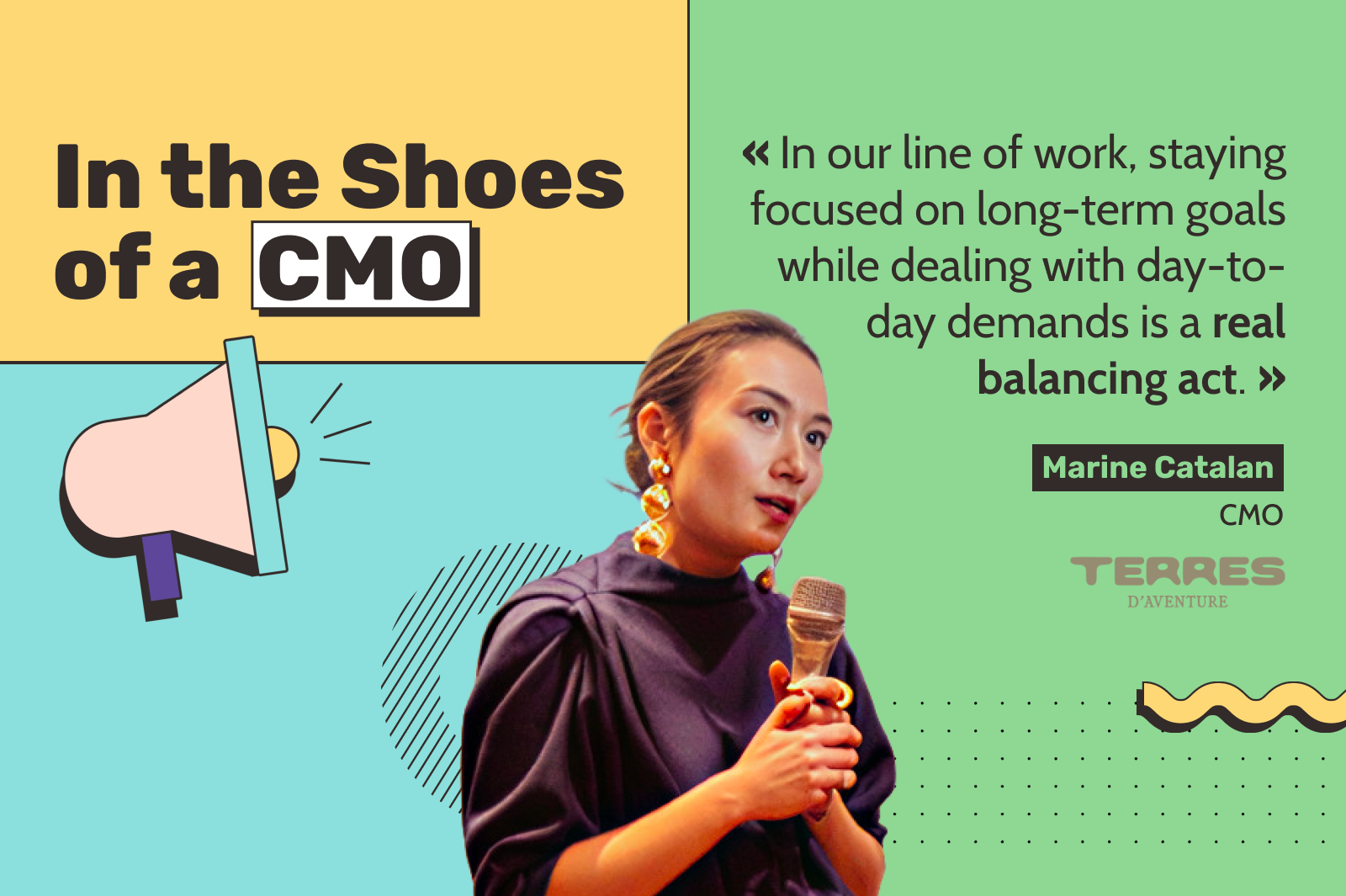
In the Shoes of a CMO: Marine Catalan (Terres d’Aventure) on Brand Transformation, Travel Marketing & Customer Experience
AI
BtoC
hypergrowth
18/12/25
In the shoes of a CMO
After a career in international agencies as a strategic planner, Marine Catalan joined Terres d’Aventure (the third brand within the Voyageurs du Monde Group) two years ago to lead marketing for an iconic adventure travel brand. Today she manages a team of seventeen people and is driving a major transformation: modernising the brand, digitising an ecosystem that has historically been heavily print-led, building a content factory, and winning over new audiences. She reflects on the challenges of her role, how traveller behaviours are evolving, the caution required around AI, and the place of marketing within a people-first organisation.
Marine Catalan: They revolve around two main areas: the brand, and acquiring new customers—with a specific goal of rejuvenation. Terres d’Aventure is a house with fifty years of history. Its image was well established, but not really revisited. We needed to modernise it, harmonise it, and give it a coherent territory aligned with today’s travellers’ expectations. The second challenge is reaching new audiences. Our historic customer base is very loyal and deeply attached to our DNA, but it’s ageing with us. To keep growing, we need to create more accessible entry points and work on rejuvenating our customer base.
M.C.: The first year was a year of building. The communication ecosystem was still very institutional, with little social presence and few internal tools to produce content. So we structured a content factory, trained field teams to bring back content, put editorial processes in place, clarified roles, and strengthened our internal capabilities. The goal wasn’t to revolutionise everything, but to organise—to lay solid foundations and better balance the whole between brand, content, and performance.
M.C.: At Terres d’Aventure, customer knowledge is first and foremost human. Around 80% of travellers fill out a very detailed feedback report. Advisors systematically call them when they return to understand what worked and what could be improved. We also have a particularity: our teams go out into the field. They test trips, itineraries, and accommodations. They know destinations and their specificities. This regular immersion gives us a level of insight that largely compensates for the absence of large-scale quantitative studies.
M.C.: AI is gradually becoming part of travellers’ habits, especially among younger people who no longer hesitate to ask a tool to generate an initial itinerary. It’s a movement we observe, but we remain convinced that certain destinations require on-the-ground expertise that AI doesn’t yet master. We’ve tested internal agents to assist our advisors, but the answers are still sometimes too approximate to be deployed. Guiding a traveller must be perfectly reliable, especially for more demanding trips. On the content side, we’re moving cautiously: our work relies on emotion, lived experience, and technical accuracy.
M.C.: Even if part of the research starts online, conversion very often happens through a phone call. Adventure travel is a complex product: physical level, safety, and the technicality of the itinerary. Having a specialised advisor who knows the terrain and the traveller’s real level remains reassuring. Physical agencies are less frequented than before, but the phone has become a key channel. In our model, it’s still the human relationship that converts.
M.C.: Internalisation is deeply rooted culturally, and it works well for certain topics—especially because our teams have real product expertise. But there has been a desire to rebalance. We now work with a branding agency, a digital agency, and a PR agency. That brings perspective and specialised skills, and it also helps relieve teams that are heavily solicited on large-scale projects. The idea isn’t to replace internal teams, but to open things up and find a more hybrid and agile model.
M.C.: It’s a determining factor. We offer 1,600 trips across 145 destinations, with very different difficulty levels, formats, and timings. It’s impossible to support each product individually: marketing has to create value elsewhere—through the brand, expertise, and advice. Our value lies in our ability to inspire, guide, and reassure, more than in a linear attribution mechanism.
M.C.: It’s one of the most sensitive challenges. Marketing must respond to a very operational day-to-day, but it also has to prepare for the years ahead: rejuvenating a brand, evolving positioning, retaining new audiences. In a company where cycles are long and performance is naturally monitored, we need to remind people that some effects aren’t measured week to week, but over time. Holding that course while supporting immediate needs is a very subtle balance.
M.C.: Three. First, leadership, because you need to maintain team momentum and defend a vision in a fast-moving environment. Second, flexibility: behaviours, tools, and priorities change quickly. Finally, creativity, which remains essential in a sector where emotion and storytelling make the difference. Even with data, even with tools, we’re still in a business of inspiration.
M.C.: I would ask marketing to protect the long-term vision. Our role is to support how travel is evolving, modernise the brand, create desire, and open the door to new audiences. It’s work that requires time, consistency, and coherence. Marketing is both exposed and structuring: it must stay the course, even when day-to-day life speeds up.
L’équipe Spaag.
Spaag is a consulting firm specialising in growth marketing, digital marketing, data, and AI. Our mission is to support our B2B and B2C clients in achieving their business objectives, both in France and internationally.


.png)

