In the shoes of a CMO: Júlia Blum (NAOS) on International Beauty Marketing, Brand Strategy & Growth
BtoC
Growth Marketing
hypergrowth
13/3/26
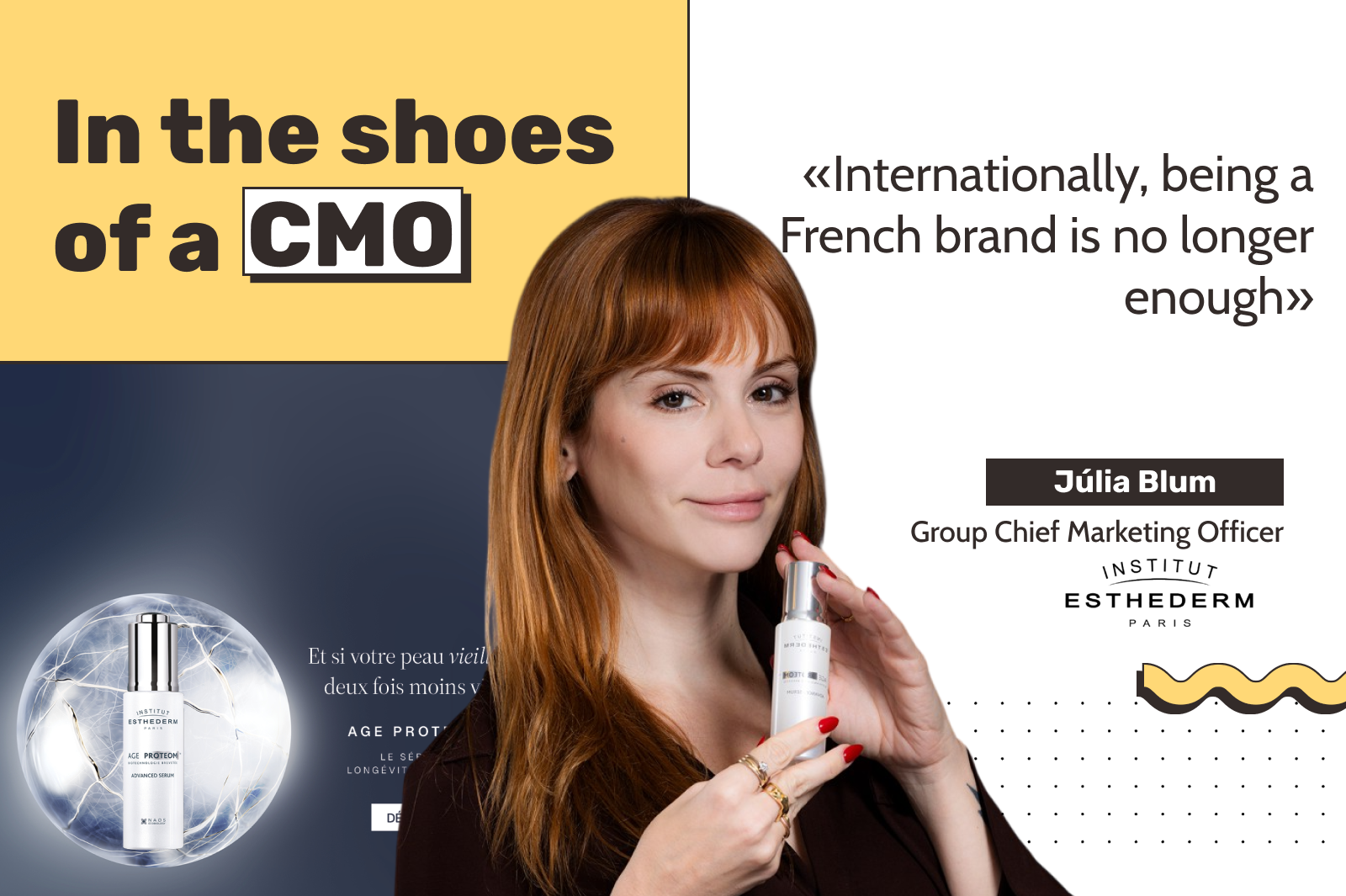
In the shoes a CMOJúlia Blum (NAOS): "Being a French brand is no longer enough internationally"
Júlia Blum is International Marketing Director at NAOS, the French cosmetics group behind three brands: Bioderma, Institut Esthederm and Etat Pur. She leads international marketing for Institut Esthederm, a brand distributed through pharmacies, beauty institutes and healthcare professionals.
Her role is to act as the interface between the brand and its priority markets: protecting brand integrity, structuring marketing plans, supporting campaigns, managing budget arbitration and preparing launches in countries where the brand is looking to accelerate.
Júlia Blum: For a long time, being a French brand was already a major advantage in skincare. It remains a strength, but the beauty market has become far more plural. We're seeing the rise of K-Beauty, J-Beauty, C-Beauty and the emergence of many brands from very different universes.
This is profoundly changing the relationship consumers have with brands. Today's consumers want to see themselves reflected in a brand that speaks directly to them. It's no longer just about projecting an image of French beauty. The challenge is to adapt our messages, our products and our codes to needs that are both functional and emotional — while maintaining global coherence.
J.B: It starts at product development. If you want to grow a brand in specific markets, you need to account for their particular needs rather than thinking purely in terms of a generic international logic.
It also shapes our communications. Visuals, model diversity and messaging all need to be adapted by country. Representation and cultural acceptability have become structuring issues for staying locally relevant.
J.B: AI helps us primarily on back-office topics. I work with around fifteen priority markets, so I face a significant challenge around consolidating information, reporting and building a clear vision to guide regional strategies.
On the creative side, however, authenticity remains central. We invest in shoots with real people and highly committed teams to preserve that authenticity. We don't use virtual models.
J.B: Today, more dedicated resources are needed at the local level. The model where you duplicated communications from one country to another no longer works. Local teams need to enrich the brand with their deep knowledge of their market.
It also changes governance. We've moved away from a top-down model toward a more horizontal logic — working increasingly through workshops with country teams, in a spirit of exchange and co-construction.
J.B: That tension has always existed. Marketing pushes to invest, and part of my role is to encourage countries to maintain a sufficient level of investment, especially in a highly competitive environment.
But it depends heavily on market maturity. Investment logic differs by country. You need to find the right balance between investment, profitability and brand awareness-building — particularly for a brand still in an expansion phase.
J.B: First, a real openness of mind. The market moves fast, levers shift and tools evolve. You need to be flexible, adaptable and able to quickly identify opportunities — especially with constrained budgets.
Second, deep knowledge of the local market is essential. To launch and grow a brand, you need specialists who understand the expectations, codes and priorities of their country. The model is becoming increasingly collaborative, which requires strong local teams.
Finally, the human factor is decisive. The difference is made through engagement — knowing how to energise a team, get the best from each person and create collective momentum matters just as much as technical choices. Consumers are not just buyers. They are people with personal, emotional and collective needs — including around ethics, impact and sustainability.
J.B: The first criterion is alignment on ethical values: transparency and business ethics are prerequisites. Brands carry a strong responsibility on these issues and consumers are paying close attention.
I also believe strongly in the role of the brand in onboarding partners. You can't properly evaluate an agency if you haven't given them genuine immersion in the brand first. They need to understand its essence, positioning and values. For a challenger brand, the question is simple: why would a consumer choose us over a long-established brand? That requires a holistic approach — not just media optimisation.
Freelancers have their place for tactical needs. For brand-building topics, however, I believe in long-term relationships. When an agency or consultancy accompanies a brand over time, you gain in efficiency, optimise campaigns more effectively and significantly reduce briefing time.
J.B: A large part of my role is to provide a clear framework: priorities and ground rules. The most common trap at country level is wanting to do everything at once. Even a large market gains nothing from multiplying big campaigns without prioritisation.
You need to define strategic priorities, choose the right levers for each objective — awareness, acquisition, profitability — and sometimes accept delaying a launch or campaign. I prefer building strong, coherent waves rather than a succession of small actions with no real impact.
J.B: Hyperpersonalisation will continue, but I also see a strong rise in consumer expectations around positive brand impact, ethics and transparency.
Consumers are increasingly attentive to promises. In skincare, and particularly in anti-ageing, there is a lot of over-promising. Brands will need to explain more, educate more and provide proof — rather than multiplying spectacular claims.
L’équipe Spaag.
Spaag is a consulting firm specialising in growth marketing, digital marketing, data, and AI. Our mission is to support our B2B and B2C clients in achieving their business objectives, both in France and internationally.