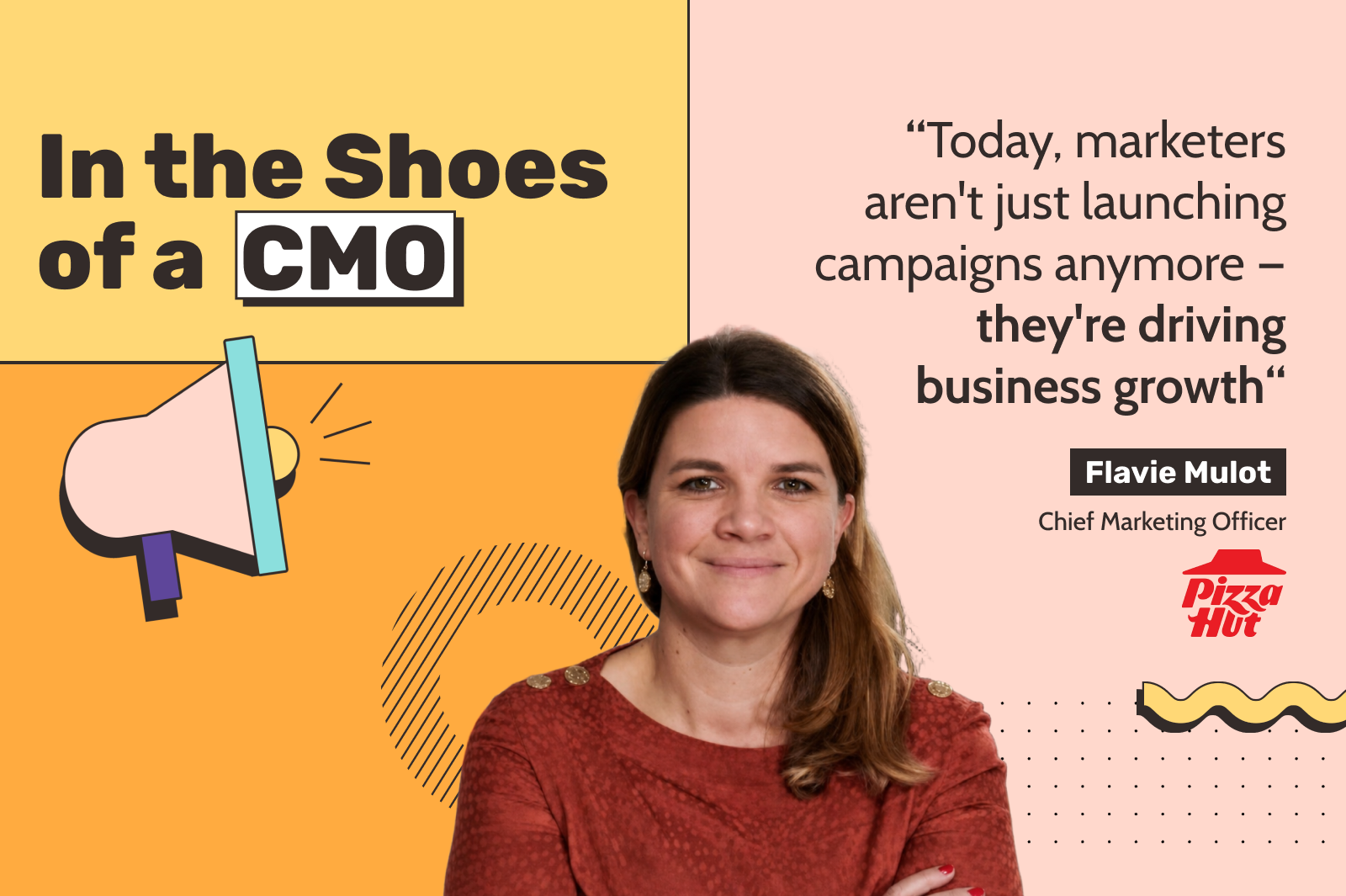
In the Shoes of a CMO: Flavie Mulot (Pizza Hut) on driving business, profitability and marketing transformation
BtoC
Marketing
8/7/26
Six months after joining Pizza Hut France, Flavie Mulot embodies a highly practical and business-oriented evolution of the CMO role. As Marketing and Supply Director, she oversees the brand, performance, product offering and part of the company’s purchasing and logistics operations.
In a fully franchised network, marketing must have a direct impact on restaurant profitability. Within a company undergoing a major transformation following its direct takeover by Yum!, her role sits at the intersection of several priorities: growth, profitability, alignment and execution. This evolution says a great deal about how the marketing function is being redefined within a franchise network.
Flavie Mulot: The main challenge is the constant trade-off between growth and profitability. In a network of franchise partners, every marketing decision has a direct impact on operations. We cannot simply focus on media performance or volume. A campaign may perform very well on paper, but if it does not generate traffic in restaurants, it has not fulfilled its purpose.
The franchise model fundamentally changes the way marketing is managed. We naturally move further down the sales funnel, which ultimately becomes offline through in-store traffic. Every decision must therefore be assessed according to its real business impact, rather than visibility or digital performance alone.
The second challenge is alignment. We have to work across several levels of decision-making, involving local teams, franchisees, regional teams and global teams. The role is as much about setting a direction as it is about bringing together stakeholders whose priorities may sometimes differ.
F.M.: My role remains consumer-focused, but it operates within a very strong B2B2C model. Everything I implement must both meet customer expectations and work economically for our franchise partners. That requires a constant balance.
For example, at lunchtime, we needed to position ourselves within a price point of between €5 and €6, which represents a significant part of the market. The launch of Crafted Flatzz, an individual oval-shaped pizza, allowed us to address this occasion with a relevant product offering.
At the same time, dialogue with our franchise partners is continuous. It is not simply about presenting plans to them, but about building those plans together. Marketing becomes a tool for balancing consumer appeal with the economic viability of the network.
F.M.: We have launched a significant technological transformation, including the renewal of our point-of-sale systems, website, app and CRM. This should allow us to activate more effective business levers and develop a better understanding of our customers.
However, the main challenge remains human. We need to support teams, help them adopt these new tools and, above all, change the way they think. We are moving from a mindset in which technical constraints are simply accepted to one where we explore more possibilities.
This transformation puts marketing back in its rightful place: as a function directly connected to the business and to customer journeys.
F.M.: I need hybrid profiles. Beyond technical skills, the ability to work cross-functionally has become essential. Marketing today is largely about aligning, engaging and convincing people. This requires influence, communication skills and a genuine understanding of internal dynamics.
Business understanding is equally important. A marketer must be able to connect their actions to a tangible impact, prioritise effectively and understand where value can be created.
Finally, curiosity is key. In a fast-changing environment, people need to be able to identify signals, connect the dots and turn them into business opportunities.
F.M.: I see them as extensions of the team. That means they need to quickly understand the business, its challenges and its internal constraints.
The relationship should be based on co-creation. A strong partner does not simply execute. They challenge, adapt and understand how decisions are made internally. What makes the difference is their ability to connect ideas, business objectives and operational reality.
F.M.: These dimensions are not in opposition, but there is a tension that needs to be managed. Performance allows us to move quickly, test and learn. It is essential for generating short-term results, but it is not enough.
If we rely solely on promotions, we weaken the value of the brand. Conversely, brand-building creates long-term value and establishes a stronger foundation.
The challenge is therefore to make both work together: using performance to optimise and learn, while building sustainable value through the brand.
F.M.: AI is already part of the way we work, particularly when it comes to producing content more quickly, testing different approaches or structuring analyses. It delivers real efficiency gains, but it does not replace decision-making.
The value still lies in interpretation and in the ability to turn data into relevant actions. In certain areas, particularly food, its limitations are still visible. It helps us accelerate production, but it cannot yet fully replace the quality of traditionally produced, appetising content.
F.M.: I do not think it is disappearing, but it is evolving. The scope is becoming broader and more cross-functional. Today, marketing is no longer simply a communications or campaign function. It is a direct driver of business development.
In my case, I work across the brand, product offering, supply and performance. The nature of the role is changing. It is becoming more comprehensive, more operational and, above all, more directly accountable for results.
L’équipe Spaag.
Spaag is a consulting firm specialising in growth marketing, digital marketing, data, and AI. Our mission is to support our B2B and B2C clients in achieving their business objectives, both in France and internationally.