In the Shoes of a CMO: Marie-Hélène Chaffy (Vente-unique) on Customer Centricity, Customer Lifetime Value and E-commerce Acquisition
E-Commerce
Growth Marketing
9/6/26
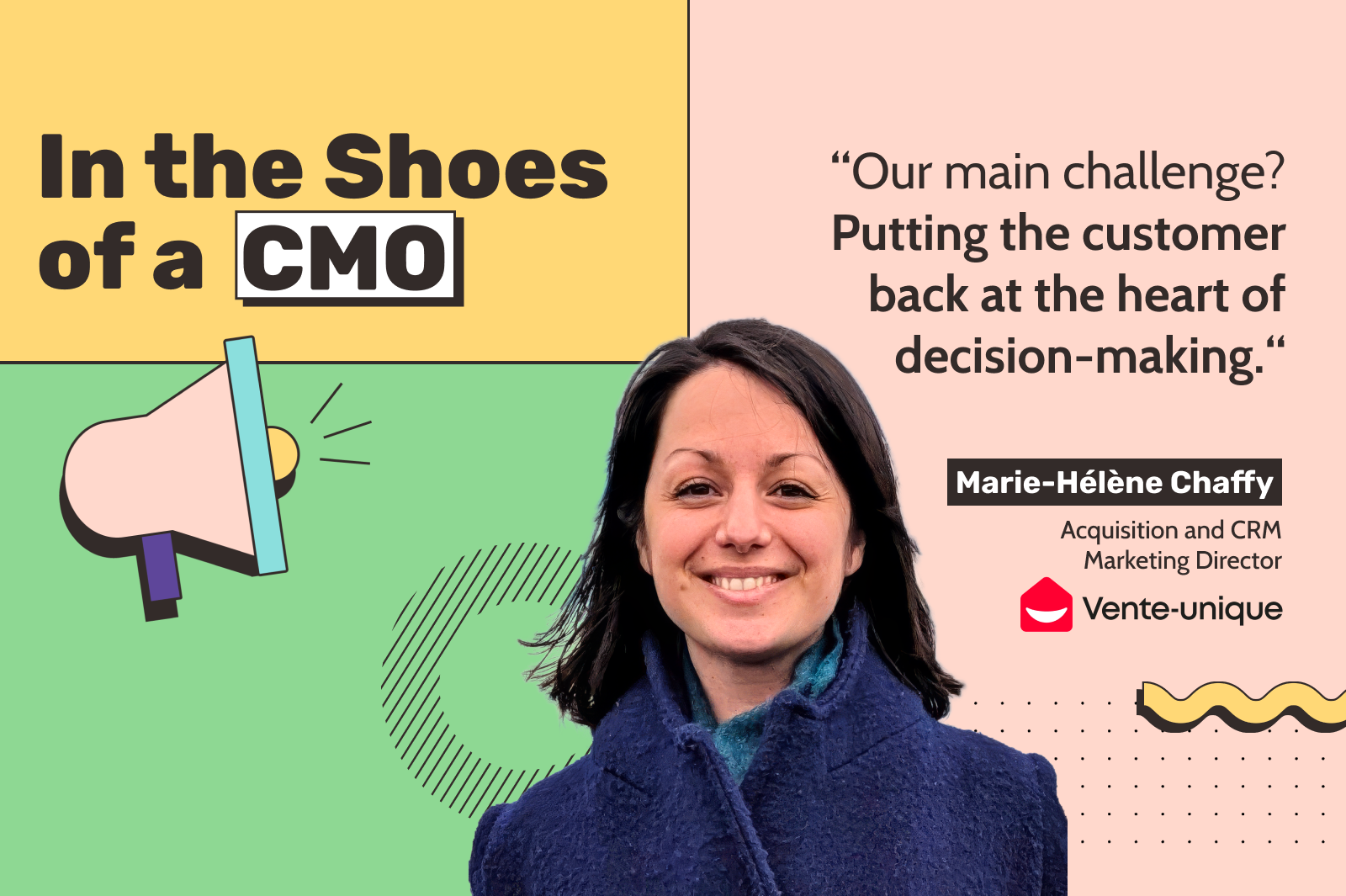
At Vente-unique, Marie-Hélène Chaffy leads acquisition marketing and CRM, overseeing SEA, paid social, SEO, UX, and customer retention. She built this scope over 13 years, starting as a Product Manager before moving into traffic acquisition at a time when the discipline was still in its infancy.
Today, she manages around 40 people within an 80-person marketing team for one of Europe’s leading online furniture and home décor retailers. The company reached €250 million in revenue in 2025 and continues to accelerate its expansion across European markets.
Marie-Hélène Chaffy: The first challenge is putting the customer back at the center of every decision. That means understanding exactly what customers are looking for before trying to sell them anything. A poorly positioned offer creates a gap that no marketing budget can compensate for. It becomes essential to adapt messaging to the customer’s level of purchase maturity.
Customers who know exactly what they want are increasingly using highly specific, long-tail search queries and tend to be extremely impatient. If they cannot quickly find what they are looking for, they leave the website without hesitation.
The second major challenge is customer lifetime value (LTV). A poor delivery experience does not simply result in a lost repeat purchase; it can also generate negative word of mouth. At a time when cost-per-click continues to rise, every visit must be maximized. Optimizing the conversion of existing traffic has become even more strategic than acquiring new prospects.
M-H.C.: It depends on the maturity of the market.
In newly launched countries, we focus primarily on the bottom of the funnel, where purchase intent is already clear. We analyze search queries coming from Google Ads and Microsoft Ads to capture highly actionable signals.
In more mature markets, our perspective expands. We work further upstream, analyzing interests and investing more heavily in paid social to reach new audiences and strengthen top-of-funnel activity. This approach broadens audience pools while improving our understanding of customer behavior.
Competitive intelligence also remains a key lever, whether through merchandising analysis, emerging social media trends, or data from Google Merchant Center. There is also an element of intuition and common sense. Monitoring competitors’ websites and email communications often reveals weak signals worth testing.
Customer service is another critical source of insight. We share reporting routines through Power BI and ensure marketing is included in the right information flows. Analyzing customer feedback helps us identify recurring pain points and quickly alert the relevant teams, particularly in logistics.
M-H.C.: We benefit from a historical advantage. Vente-unique was one of the first e-commerce pure players in France, which allowed us to learn from early mistakes and continuously refine our account structures and processes.
Today, our conversion volumes provide advertising platforms with strong signals that fuel machine-learning algorithms efficiently. This creates a performance advantage that is difficult for new entrants to replicate.
The market is becoming more concentrated. Mid-sized generalist players will struggle to absorb rising acquisition costs, while successful companies tend to be either well-established brands or highly specialized niche players.
Our strategy is built on anticipation rather than reaction. A good example is Google's announced discontinuation of Dynamic Search Ads (DSA). We have already started migrating to Performance Max campaigns so we can gather benchmark data before the transition becomes mandatory. This is only possible because of our in-house expertise and deep account knowledge.
M-H.C.: Our model requires an exceptional level of expertise and attention. In my view, an agency cannot dedicate the same amount of time to a single client or immerse itself as deeply in the business.
Generic best practices often fail because our reality depends on factors such as average order value, conversion rates, and country-specific market dynamics.
We have therefore built our own tools and analytical capabilities, using GA360 with custom events, BigQuery for advanced website analysis, and attribution platforms such as Thank You Analytics to better understand the contribution of each channel throughout the customer journey.
We have also used tools like Contentsquare for UX audits and AB Tasty for A/B testing. However, what truly creates value is not the tool itself, but how it is used.
Our marketing budget is not fixed. It is directly tied to revenue generation and adjusted continuously according to monthly performance. This gives us a level of agility that would be difficult to replicate through a fully outsourced model.
M-H.C.: Above all, we look for curious people who can adapt quickly to changes in marketing channels and market conditions.
We need individuals who can react immediately to very different situations, whether it's a Black Friday traffic surge or an economic slowdown in a specific market.
What is changing today is the nature of the skills that create differentiation. For years, we prioritized highly technical specialists capable of optimizing every channel in detail. As AI increasingly standardizes part of that expertise, competitive advantage shifts toward customer understanding, creativity, aesthetic sensitivity, and the ability to build a strong brand identity.
M-H.C.: Whenever we enter a new market, we begin with a detailed analysis of available data, including insights provided by partners such as Google. This helps us understand local demand patterns and online behaviors.
We then recruit native traffic managers for each market. This provides deep local expertise while integrating them directly into our headquarters, where they work closely with other teams and access our internal tools.
When launching in Scandinavia, for example, we hired a Swedish, a Norwegian, and a Danish traffic manager, all based at headquarters. This setup facilitates collaboration and accelerates knowledge sharing.
Their contribution is essential because customer expectations vary significantly from one country to another, whether regarding SMS marketing, pricing perceptions, taxation, or delivery expectations. These nuances require local expertise that only native professionals can truly provide.
Product strategy is adapted first, and acquisition channels are then aligned with those market realities.
M-H.C.: AI should be seen as a productivity and efficiency tool, not as a replacement for human judgment.
Its value lies primarily in automating repetitive tasks and freeing up time for analysis. For example, we have developed internal scripts that automatically audit advertising accounts at the beginning of each week, detect anomalies, and identify competitor movements. This significantly improves our responsiveness.
On the customer service side, some requests can already be handled automatically, particularly those covered by FAQs. This reduces response times and improves the overall customer experience.
Product translation has also improved considerably thanks to AI, although human validation remains essential, especially for languages where inconsistencies still occur.
More broadly, AI can never replace contextual understanding. The ability to interpret situations, understand customers, and make informed decisions remains fundamentally human.
L’équipe Spaag.
Spaag is a consulting firm specialising in growth marketing, digital marketing, data, and AI. Our mission is to support our B2B and B2C clients in achieving their business objectives, both in France and internationally.